IP vs. Traditional AV: Making the Right Choice for Your Organization
IP-based and traditional AV each have distinct advantages. Understanding when to use which approach—or how to combine them—ensures optimal performance and value for your specific needs.
The AV industry's shift toward IP-based systems has created confusion for many organizations. Should you embrace AV over IP completely? Stick with proven traditional approaches? The truth is more nuanced—each technology has specific strengths, and the best solution often combines both. Here's how to make informed decisions that serve your actual needs rather than following trends.
Understanding the Fundamental Differences
Traditional AV and IP‑based AV embody different architectures. In point‑to‑point systems, signals travel over dedicated links—HDMI, SDI, or other dedicated transport—between known endpoints. These paths are simple to reason about, introduce minimal latency, and are largely immune to congestion.
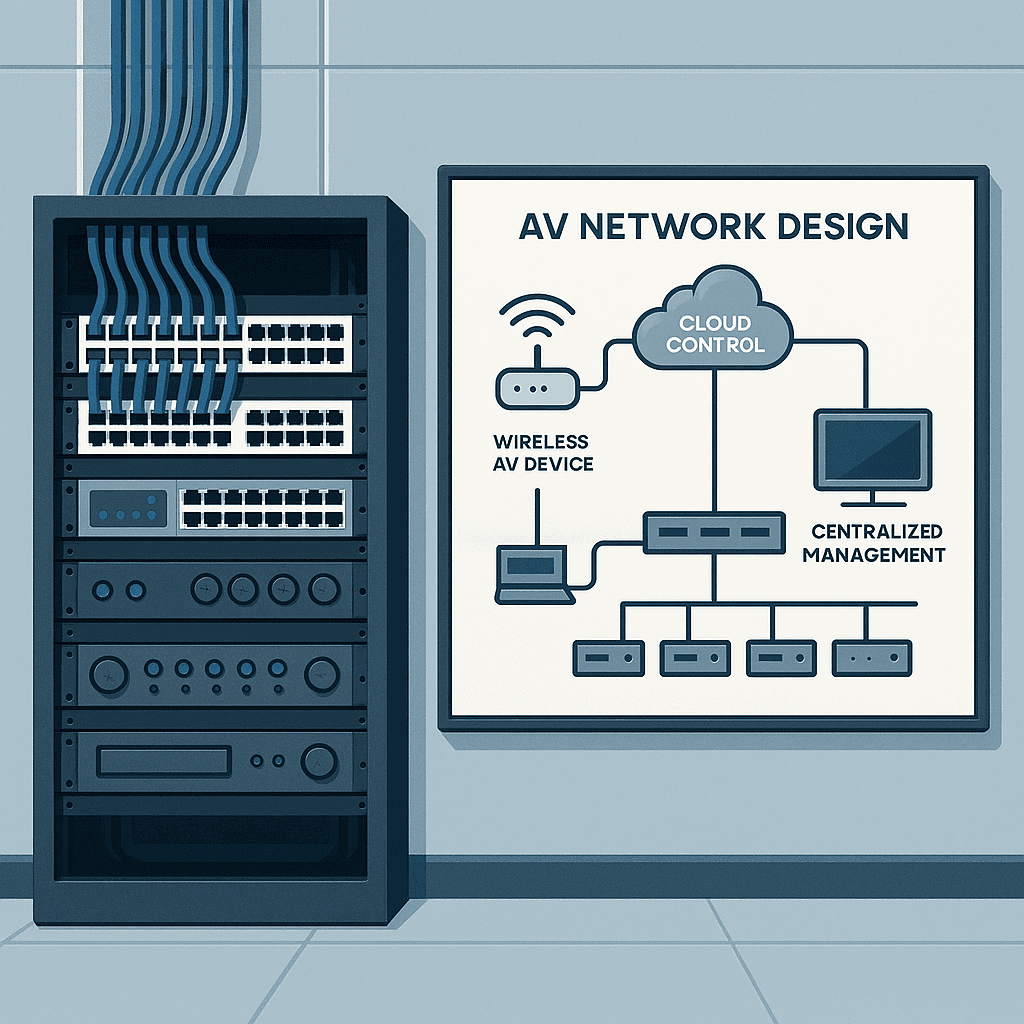
In IP‑based systems, media is packetized and rides on shared network infrastructure. This enables any‑to‑any routing, software‑defined behaviors, and centralized management, at the cost of encoding/decoding latency and the need for careful network engineering. The distinction is not ideological but practical: choose the model that matches your constraints—latency tolerance, scale, manageability, and existing infrastructure.
When Traditional AV Makes Sense
Traditional approaches are compelling when latency must be imperceptible, complexity should be minimized, or existing investments are recent. Direct HDMI paths are effectively instantaneous and ideal for highly interactive experiences—design reviews, live performance, gaming, and certain broadcast applications. One‑to‑one rooms with simple requirements don’t benefit from the overhead of encoders, decoders, and managed multicast.
Traditional also maintains an advantage where 4K/8K must be uncompressed without upgrading switching fabrics; a certified cable can be the simplest, most reliable answer. Finally, teams without network engineering resources can operate traditional systems confidently while they build capability for future IP deployments.
When IP-Based AV Shines
IP systems excel when flexibility, any‑to‑any routing, and centralized operations matter. Adding endpoints becomes a facilities exercise—pull a drop and provision software—rather than a rewiring project. Distance constraints dissolve as media hops across switches. Remote management, monitoring, and software distribution reduce operational costs and enable proactive support.
Standards maturation (SMPTE 2110, AES67, NMOS) is improving interoperability, while compressed and mezzanine codecs make high‑quality distribution feasible on mainstream networks. The trade‑off is careful network design and acceptance of encoding latency—tolerable for most collaboration and signage, less so for ultra‑interactive use cases.
The Technology Options Within IP
“IP‑based AV” spans multiple techniques. Compressed AV over IP transports high‑quality video within tens of megabits, fitting well on gigabit networks with manageable latency. SDVoE and similar approaches carry uncompressed or lightly compressed streams at 10 Gbps with near‑zero latency but demand upgraded switching.
For audio, Dante and AES67 provide low‑latency, high‑fidelity distribution with mature tooling. NDI offers software‑centric workflows popular in production contexts. Selecting among these depends on constraints: bandwidth, acceptable latency, quality targets, and operational maturity.
Hybrid Approaches: The Practical Solution
Hybrid designs often deliver the best outcomes. Use direct connections inside rooms for imperceptible latency and predictable behavior, then ride the network for inter‑room distribution. Keep mission‑critical boardrooms on traditional video paths while adopting IP audio for flexibility and zoning. Bridge technologies preserve existing investments and enable phased migration as budgets and capabilities grow.
This isn’t compromise—it’s specificity. Use the simplest tool that satisfies the requirement, reserving complexity for problems that merit it.
Making Your Decision
Evaluate decisions against six lenses: infrastructure readiness, operational maturity, scale trajectory, latency tolerance, TCO, and migration path. If your switching fabric and IT team are ready, IP unlocks powerful capabilities; if not, factor upgrade and support costs realistically. Where interaction is paramount, preserve direct paths. Where flexibility and fleet operations matter, bias toward IP. Anchor choices in present constraints and future plans so systems evolve rather than reset.
Conclusion
The IP versus traditional AV debate misses the point. This isn't about picking sides—it's about matching technology to requirements. Traditional AV delivers simplicity, low latency, and proven reliability. IP-based AV provides flexibility, scalability, and integration capabilities. The best systems leverage both.
Don't let technology trends drive decisions that your users and budgets must live with for years. Evaluate actual needs, consider total cost of ownership, and design systems that solve real problems. Sometimes that means cutting-edge IP technology. Sometimes it means proven traditional approaches. Often it means intelligent combination of both.
Key Takeaways
- •Traditional AV offers simplicity, low latency, and proven reliability.
- •IP-based AV provides flexibility, scalability, and integration capabilities.
- •The best systems often combine both approaches.
- •Choose based on actual needs, not technology trends.
- •Consider total cost of ownership and migration paths.